How many days a week should I lift weights?
Lift weights 3 days a week and you'll build muscle after 40, as long as each set is hard. A focused 45-minute session beats 90 minutes with no plan.


In this article
The workout is the shortest part of building muscle. The growth happens after you leave the gym, while you work and sleep.
Lifting weights three days a week is enough for most men over 40 to build muscle and strength. Make each one a full-body session of about 45 minutes.
The catch is effort. Lift hard enough that every set ends close to all you have. Three sessions like that take less than three hours a week.
Your muscles keep building for about a day and a half after a hard session
Your muscles grow after the workout, while you recover. A hard set is the signal. It strains the muscle fibers. In the hours after, your body repairs them and adds new protein to them. That process is called muscle protein synthesis.
A lab in Canada measured how long that building lasts. Young men did 12 hard sets of curls with one arm and rested the other. A day later, the worked arm was building muscle more than twice as fast. By 36 hours, it was almost back to normal.
Muscle building in the worked arm, compared with the resting arm
Muscle building more than doubles a day after one hard session, then fades by 36 hours
- 4 hours afterBuilding already well underway, 50% above the resting arm
- 24 hours afterThe highest of the three readings, 109% above the resting arm
- 36 hours afterBack near the resting arm, 14% above the resting arm, too small to count
Each reading comes from six men who did heavy curls on one side and kept the other arm at rest. The first two come from Chesley 1992, the last from MacDougall 1995.
That day and a half is when your muscle gets built. It’s built from the protein you eat, so eat protein at every meal.
We set clients at 2 grams of protein per kilogram of current body weight a day. For a 200-pound man, that’s about 180 grams.
Each session adds a little muscle. In your first few weeks, much of what your body builds goes to repair. Once your muscles adapt, more of it goes to growth. Train each muscle every two or three days to get it building again.
Strength comes faster than size. Early on, your nervous system learns each lift, so the weights go up before the mirror changes much. The muscle catches up over the following months.
Three days a week of lifting weights builds muscle when every set is hard
Fewer sessions work only when each one is intense and challenging.
On a hard set, the last two reps should slow down. You should feel like you’re pushing with everything you have. Your breathing gets heavy. You could get one more clean rep, maybe two, and no more.
End every working set there. When you lift too light, you build less muscle.
More hard sets build more muscle. Aim for at least four hard sets per muscle each week. Three full-body sessions get you there easily.
When we simplify a client’s training to only three days, he sticks with it far better. Even for a busy executive with long work hours and frequent travel, three days is doable and sustainable. We make it work as long as his nutrition and recovery support the load.
Blake hadn’t trained in 12 years when he started our program. We set him up with three full-body sessions per week.
Client result, body weight
Blake was down 11 pounds in 7 weeks
Three lifting days a weekSleeping betterFeeling stronger
He lost the weight on our full program, with his nutrition and sleep coached alongside the lifting.
With three days, make every session full-body
A full-body workout trains every major muscle. Three full-body workouts a week train each muscle three times.
The other common way to set up your week is a split. A split gives each part of your body its own workout, like chest on Monday and legs on Wednesday. With three workouts a week, a split trains each muscle once.
Training each lift more often, as you do in full-body sessions, can make you stronger faster if done properly.
Call your three sessions A, B, and C. Run them in that order on whatever days work. If you miss a day, pick up where you left off. Each session starts with a different main lift, so two days in a row is fine when your schedule forces it.
Each session takes about 45 minutes
Ninety minutes in the gym for its own sake is wasted time. Plenty of men spend it scrolling their phones, wandering between machines, and lifting with no purpose or effort. They’re there to be there and feel like they’re doing something.
Focus, precision, and intensity get more done in less time.
Build each session around a squat or deadlift, plus a pull and a push. Run it in this order.
- A warm-up built into the session
- The first big lift, one heavy top set and two lighter back-off sets
- The second big lift
- Smaller lifts paired for opposite muscles, done back to back
- Core work and a short finisher
Rest two to three minutes after each heavy set. Trained men who rested three minutes gained more squat and bench strength than men who took one.
Pairing gets the same sets done in about half the time, with 90 seconds of rest after each round.
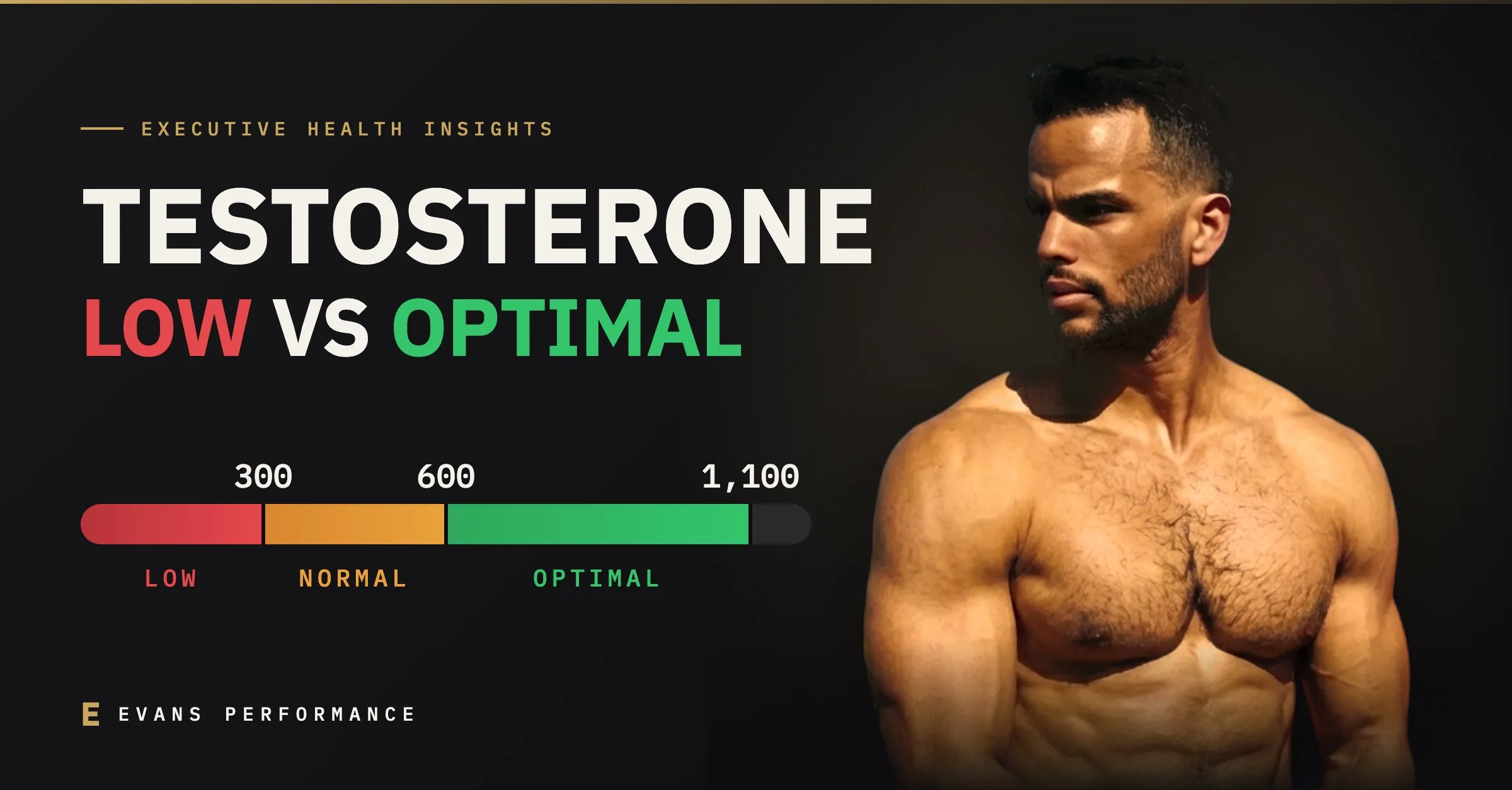
Testosterone helps build muscle. Big lifts that use a lot of muscle raise it for 15 to 30 minutes after a session.
Heavy lifting is one of eight habits we use to raise our clients’ testosterone naturally. Our free guide, Fix Your Testosterone, gives you the other seven.
A 30-minute day still counts if it gets through the warm-up, your first main lift, and one paired round.
To lose fat or build muscle, lift three days and walk every day
Three lifting sessions a week work whether you want to lose fat, build muscle, or both. What you eat decides which of those you get. A man who trains hard can be eating too little as easily as too much. If fat loss is the goal, men in their 40s should aim for 12 to 15% body fat.
Walk every day, including lifting days. Walking helps you recover between sessions.
Even an easy walk puts your muscles to work clearing sugar from your blood. Short walks during long desk hours keep blood sugar steadier after meals.
The target is 10,000 steps a day, with a minimum of 7,500. If you’re starting low, add 2,000 to 3,000 at a time.
Add weight before you add days
Adding weight to the bar is the first way to progress. Once your heaviest set hits the top of its rep range, go up next time. Upper-body lifts take 5 more pounds and lower-body lifts take 10.
If you’re starting out or coming back after years away, begin with two or three sessions a week. A fourth or fifth day can help after three to six months of consistent lifting. Add it once you’re eating enough to fuel your training and sleeping well.
When you’re lifting heavy and progressing fast, a deload week of lighter weights about every six weeks keeps you fresh.
On a sore or run-down day, skip the finisher and cut any jumps or throws to two sets. If you feel strong, push. Pain above 3 out of 10 ends that exercise.
In a busy week, two sessions keep what you’ve built
Strength outlasts a break. Adults who stopped lifting for 32 weeks kept most of the strength they had built.
Muscle size takes more upkeep with age. Lifters aged 20 to 35 kept their new muscle on one session a week. Those aged 60 to 75 needed up to two, with the weights kept heavy.
If you’re between 40 and 60, you fall between those groups, so two sessions a week cover you.
After 50, keep lifting heavy
Sarcopenia is the loss of muscle and strength that comes with age. On average, muscle mass starts dropping noticeably around 50.
Strength training is the main treatment for it. Eating enough protein helps too.
A three-day week still works after 50. Studies of middle-aged and older lifters found similar strength gains whether they trained fewer days a week or more.
Sarcopenia hits the legs hardest. Train quads, hamstrings, and calves all year. Add a heavy carry too, like walking with a dumbbell in each hand.
If you haven’t loaded a barbell squat or deadlift lately, start with a heavy goblet squat or a trap bar deadlift.
Three heavy days a week keep building muscle at 50 and at 60.
The whole plan, in six habits
Building muscle after 40 takes less than three hours a week of hard lifting. Six habits get you there.
- Lift three days a week, in full-body sessions of about 45 minutes.
- End every working set with one or two reps left.
- Eat protein at every meal.
- Walk every day, including lifting days.
- Add weight before you add days.
- In a busy week, get two sessions in.
You can keep this plan for years.
If you want these habits built around your labs and your calendar, watch how we build each client’s training program here.

Watch the video
See the whole system, from your first blood draw to your weekly check-ins, in under 10 minutes.
Sources
- [1] Damas F, Phillips SM, Libardi CA, et al. Resistance training-induced changes in integrated myofibrillar protein synthesis are related to hypertrophy only after attenuation of muscle damage. J Physiol. 2016;594(18):5209-22.
- [2] Morton RW, Murphy KT, McKellar SR, et al. A systematic review, meta-analysis and meta-regression of the effect of protein supplementation on resistance training-induced gains in muscle mass and strength in healthy adults. Br J Sports Med. 2018;52(6):376-384.
- [3] MacDougall JD, Gibala MJ, Tarnopolsky MA, MacDonald JR, Interisano SA, Yarasheski KE. The time course for elevated muscle protein synthesis following heavy resistance exercise. Can J Appl Physiol. 1995;20(4):480-6.
- [4] Chesley A, MacDougall JD, Tarnopolsky MA, Atkinson SA, Smith K. Changes in human muscle protein synthesis after resistance exercise. J Appl Physiol (1985). 1992;73(4):1383-8.
- [5] Folland JP, Williams AG. The adaptations to strength training: morphological and neurological contributions to increased strength. Sports Med. 2007;37(2):145-68.
- [6] Robinson ZP, Pelland JC, Remmert JF, et al. Exploring the Dose-Response Relationship Between Estimated Resistance Training Proximity to Failure, Strength Gain, and Muscle Hypertrophy: A Series of Meta-Regressions. Sports Med. 2024;54(9):2209-2231.
- [7] Schoenfeld BJ, Ogborn D, Krieger JW. Dose-response relationship between weekly resistance training volume and increases in muscle mass: A systematic review and meta-analysis. J Sports Sci. 2017;35(11):1073-1082.
- [8] Iversen VM, Norum M, Schoenfeld BJ, Fimland MS. No Time to Lift? Designing Time-Efficient Training Programs for Strength and Hypertrophy: A Narrative Review. Sports Med. 2021;51(10):2079-2095.
- [9] Grgic J, Schoenfeld BJ, Davies TB, Lazinica B, Krieger JW, Pedisic Z. Effect of Resistance Training Frequency on Gains in Muscular Strength: A Systematic Review and Meta-Analysis. Sports Med. 2018;48(5):1207-1220.
- [10] Schoenfeld BJ, Pope ZK, Benik FM, et al. Longer Interset Rest Periods Enhance Muscle Strength and Hypertrophy in Resistance-Trained Men. J Strength Cond Res. 2016;30(7):1805-12.
- [11] Kraemer WJ, Ratamess NA. Hormonal responses and adaptations to resistance exercise and training. Sports Med. 2005;35(4):339-61.
- [12] Richter EA, Hargreaves M. Exercise, GLUT4, and skeletal muscle glucose uptake. Physiol Rev. 2013;93(3):993-1017.
- [13] Buffey AJ, Herring MP, Langley CK, Donnelly AE, Carson BP. The Acute Effects of Interrupting Prolonged Sitting Time in Adults with Standing and Light-Intensity Walking on Biomarkers of Cardiometabolic Health in Adults: A Systematic Review and Meta-analysis. Sports Med. 2022;52(8):1765-1787.
- [14] American College of Sports Medicine. American College of Sports Medicine position stand. Progression models in resistance training for healthy adults. Med Sci Sports Exerc. 2009;41(3):687-708.
- [15] Bickel CS, Cross JM, Bamman MM. Exercise dosing to retain resistance training adaptations in young and older adults. Med Sci Sports Exerc. 2011;43(7):1177-87.
- [16] Spiering BA, Mujika I, Sharp MA, Foulis SA. Maintaining Physical Performance: The Minimal Dose of Exercise Needed to Preserve Endurance and Strength Over Time. J Strength Cond Res. 2021;35(5):1449-1458.
- [17] Janssen I, Heymsfield SB, Wang ZM, Ross R. Skeletal muscle mass and distribution in 468 men and women aged 18-88 yr. J Appl Physiol (1985). 2000;89(1):81-8.
- [18] Dent E, Morley JE, Cruz-Jentoft AJ, et al. International Clinical Practice Guidelines for Sarcopenia (ICFSR): Screening, Diagnosis and Management. J Nutr Health Aging. 2018;22(10):1148-1161.
- [19] Peterson MD, Sen A, Gordon PM. Influence of resistance exercise on lean body mass in aging adults: a meta-analysis. Med Sci Sports Exerc. 2011;43(2):249-58.
This article is for educational purposes only and is not medical advice. Consult your physician before making changes to your health, training, or supplementation.