What body fat percentage should a man in his 40s be?
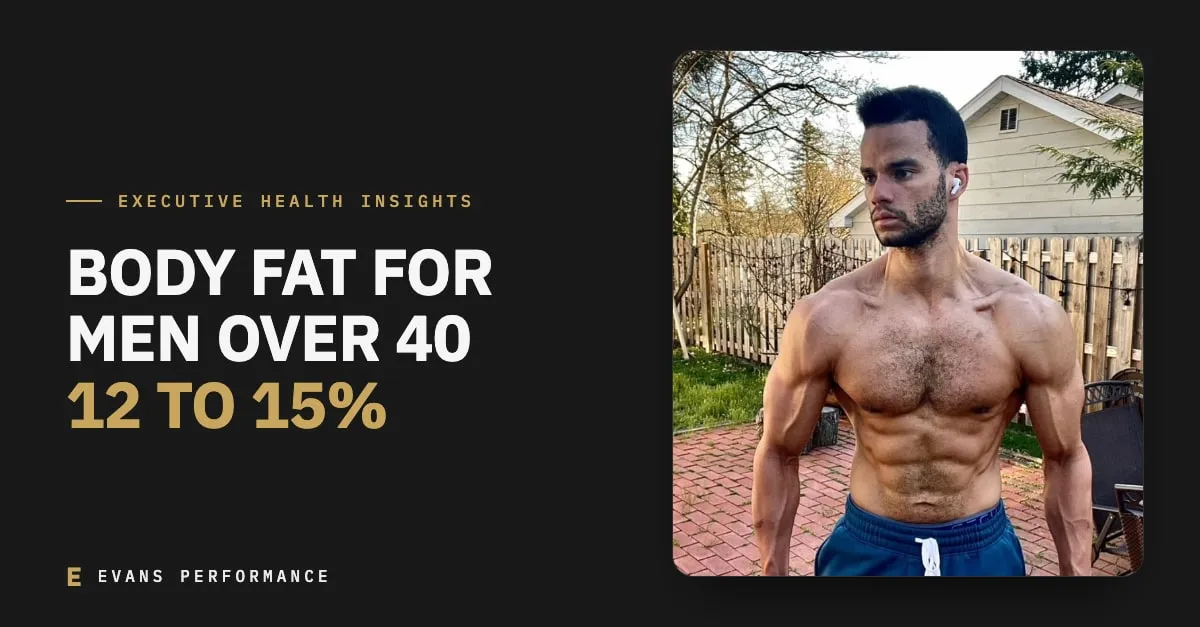
A man in his 40s should aim for 12 to 15% body fat. Visceral fat shrinks faster than the fat under your skin, so your health improves before your abs show.

Belly fat comes up on more of my calls than anything else about the body. For your health, the belly is where fat matters most.
For a man in his 40s, 12 to 15% body fat is the target.
Most age charts put the healthy limit at about 21%, where disease risk starts to climb. The average American man carries about 28%.
Body fat percentage
Our target sits well below the charts' healthy limit
- Healthy limit on age chartsMen in their 40s, about 21%
- Average American manAdult men, all ages, about 28%
At 12 to 15%, you look lean and athletic, with abs that usually show at the low end. After coaching more than 150 executives, I set the target there because a man can stay close to his best shape and still enjoy client dinners, travel weeks, and weekends with friends.
The bigger payoff is your health. Some of your belly fat sits deep inside, packed around your organs. This deep layer, called visceral fat, is the one most closely tied to inflammation, diabetes, and heart disease. Getting to 12 to 15% shrinks your visceral fat, starting with the first few pounds you lose.
Men store more of their fat deep in the belly
Belly fat sits in two layers. Subcutaneous fat lies just under your skin, the soft layer you can pinch. Visceral fat sits deeper, under your abdominal muscles, around your liver, stomach, and intestines.
Compared with a woman at the same body fat, a man carries more visceral fat and adds it faster as he gains. The gap helps explain why extra fat carries more health risk for men.
Age pushes more of your fat inward. As men get older, visceral fat tends to climb, even when their weight and waist hold steady.
The size of your belly shows both layers together, so the mirror can’t tell you how much of it is visceral. Your body fat percentage counts both layers too. A man can look average in a dress shirt and still carry plenty of visceral fat. BMI can’t see it either, because BMI only uses your height and weight.
Visceral fat sends inflammation straight to your liver
Compared with the fat under your skin, visceral fat holds more inflammatory cells and releases its stored fat into your blood more readily. Blood from visceral fat drains through the portal vein directly into your liver, so your liver gets that fat and those inflammatory signals before the rest of your body does.
Over time, the load makes your liver resist insulin and store fat of its own. Your blood sugar creeps up. Inflammation builds throughout your body.
The Framingham Heart Study shows what the deep fat does to your risk. Researchers measured both layers with CT scans in about 3,000 adults, average age 50, then compared each layer with blood pressure, blood sugar, cholesterol, and diabetes. Both layers tracked with those risks, the visceral layer more closely.
Inflammation in the blood followed the same pattern. Over the next five years, the people with more visceral fat developed more heart disease and cancer, even at the same BMI. Two men can weigh the same and wear the same size pants yet carry very different risk, depending on how much of their fat sits around their organs.
Losing fat improves your blood sugar, blood pressure, and testosterone
Once you start losing weight, visceral fat shrinks faster than subcutaneous fat. The gap is widest in the first stretch of fat loss. With less fat and fewer inflammatory signals reaching your liver, insulin works better and your blood sugar settles. Fix Your Metabolism goes marker by marker through the insulin side.
Blood pressure falls as the weight comes off. The top number typically drops about 5 points for every 10 pounds you lose.
Testosterone tends to rise in proportion to the weight you lose and fall with the weight you gain.
Measure your body fat and visceral fat with a DEXA scan
Home methods disagree with each other. In one month, my smart scale and two tape-measure formulas put me anywhere from 12.4% to 15.2%.
For your real number, get a DEXA scan. The low-dose X-ray measures your fat, muscle, and bone, with your visceral fat as its own number on the report. Repeat it every three months on the same machine, since scanners from different makers read fat differently. An InBody, the body composition machine many gyms and clinics have, works if that’s what you can get.
Between scans, your smart scale and a tape measure show which way your body fat is moving. Measure your waist at the navel once a week, first thing in the morning. Keep it under half your height, which is 36 inches for a 6-foot man.
If your weight and waist drop together, you’re losing fat. If your weight holds while your waist shrinks, you’re losing fat and building muscle.
How long does it take to get to 15% body fat?
From 20%, plan on three months or more. A 200-pound man who keeps his muscle has about 12 pounds of fat to lose.
From 28%, plan on six months or more. A 200-pound man starting there has about 30 pounds of fat to lose.
Our average fat loss client drops 1 to 4% body fat in the first month. Two of our strongest results started near 20%.
- A physical therapist in his forties went from 19% to 11% body fat in 16 weeks. His waist went from 38 to 32 inches in the first 90 days.
- A VP in construction went from 19% to 13% in four months.
Losing muscle slows the drop in your body fat percentage, so protect it. Eat about 1 gram of protein per pound of your goal body weight, lift weights, and aim for 10,000 steps a day. If the number stalls, look first at what you eat and how much you move outside the gym. Why you can work out and still not lose weight walks through both.
Free Executive Health Score
See where you stand.
Seven quick questions get you a letter grade, a read on each area of your health, and the one area costing you the most.
Example result
- Body composition Needs work
- Nutrition Needs work
- Sleep Solid
- Alcohol Strong
What's costing you the most Body composition Fix it and this score goes from 68 to 78.
Sources
- [1] Gallagher D, Heymsfield SB, Heo M, Jebb SA, Murgatroyd PR, Sakamoto Y. Healthy percentage body fat ranges: an approach for developing guidelines based on body mass index. Am J Clin Nutr. 2000;72(3):694-701.
- [2] Li C, Ford ES, Zhao G, Balluz LS, Giles WH. Estimates of body composition with dual-energy X-ray absorptiometry in adults. Am J Clin Nutr. 2009;90(6):1457-65.
- [3] Lemieux S, Prud'homme D, Bouchard C, Tremblay A, Després JP. Sex differences in the relation of visceral adipose tissue accumulation to total body fatness. Am J Clin Nutr. 1993;58(4):463-7.
- [4] Kuk JL, Saunders TJ, Davidson LE, Ross R. Age-related changes in total and regional fat distribution. Ageing Res Rev. 2009;8(4):339-48.
- [5] Ibrahim MM. Subcutaneous and visceral adipose tissue: structural and functional differences. Obes Rev. 2010;11(1):11-8.
- [6] Item F, Konrad D. Visceral fat and metabolic inflammation: the portal theory revisited. Obes Rev. 2012;13 Suppl 2:30-9.
- [7] Fox CS, Massaro JM, Hoffmann U, et al. Abdominal visceral and subcutaneous adipose tissue compartments: association with metabolic risk factors in the Framingham Heart Study. Circulation. 2007;116(1):39-48.
- [8] Pou KM, Massaro JM, Hoffmann U, et al. Visceral and subcutaneous adipose tissue volumes are cross-sectionally related to markers of inflammation and oxidative stress: the Framingham Heart Study. Circulation. 2007;116(11):1234-41.
- [9] Britton KA, Massaro JM, Murabito JM, Kreger BE, Hoffmann U, Fox CS. Body fat distribution, incident cardiovascular disease, cancer, and all-cause mortality. J Am Coll Cardiol. 2013;62(10):921-5.
- [10] Chaston TB, Dixon JB. Factors associated with percent change in visceral versus subcutaneous abdominal fat during weight loss: findings from a systematic review. Int J Obes (Lond). 2008;32(4):619-28.
- [11] Neter JE, Stam BE, Kok FJ, Grobbee DE, Geleijnse JM. Influence of weight reduction on blood pressure: a meta-analysis of randomized controlled trials. Hypertension. 2003;42(5):878-84.
- [12] Camacho EM, Huhtaniemi IT, O'Neill TW, et al. Age-associated changes in hypothalamic-pituitary-testicular function in middle-aged and older men are modified by weight change and lifestyle factors: longitudinal results from the European Male Ageing Study. Eur J Endocrinol. 2013;168(3):445-55.
- [13] Kaul S, Rothney MP, Peters DM, et al. Dual-energy X-ray absorptiometry for quantification of visceral fat. Obesity (Silver Spring). 2012;20(6):1313-8.
- [14] Imboden MT, Welch WA, Swartz AM, et al. Reference standards for body fat measures using GE dual energy x-ray absorptiometry in Caucasian adults. PLoS One. 2017;12(4):e0175110.
- [15] Browning LM, Hsieh SD, Ashwell M. A systematic review of waist-to-height ratio as a screening tool for the prediction of cardiovascular disease and diabetes: 0·5 could be a suitable global boundary value. Nutr Res Rev. 2010;23(2):247-69.
This article is for educational purposes only and is not medical advice. Consult your physician before making changes to your health, training, or supplementation.