
Why am I always tired even though my blood work is normal?
When a tired executive's blood work comes back normal, these are the five markers we check first, what optimal looks like for each, and what moves them.
In this article
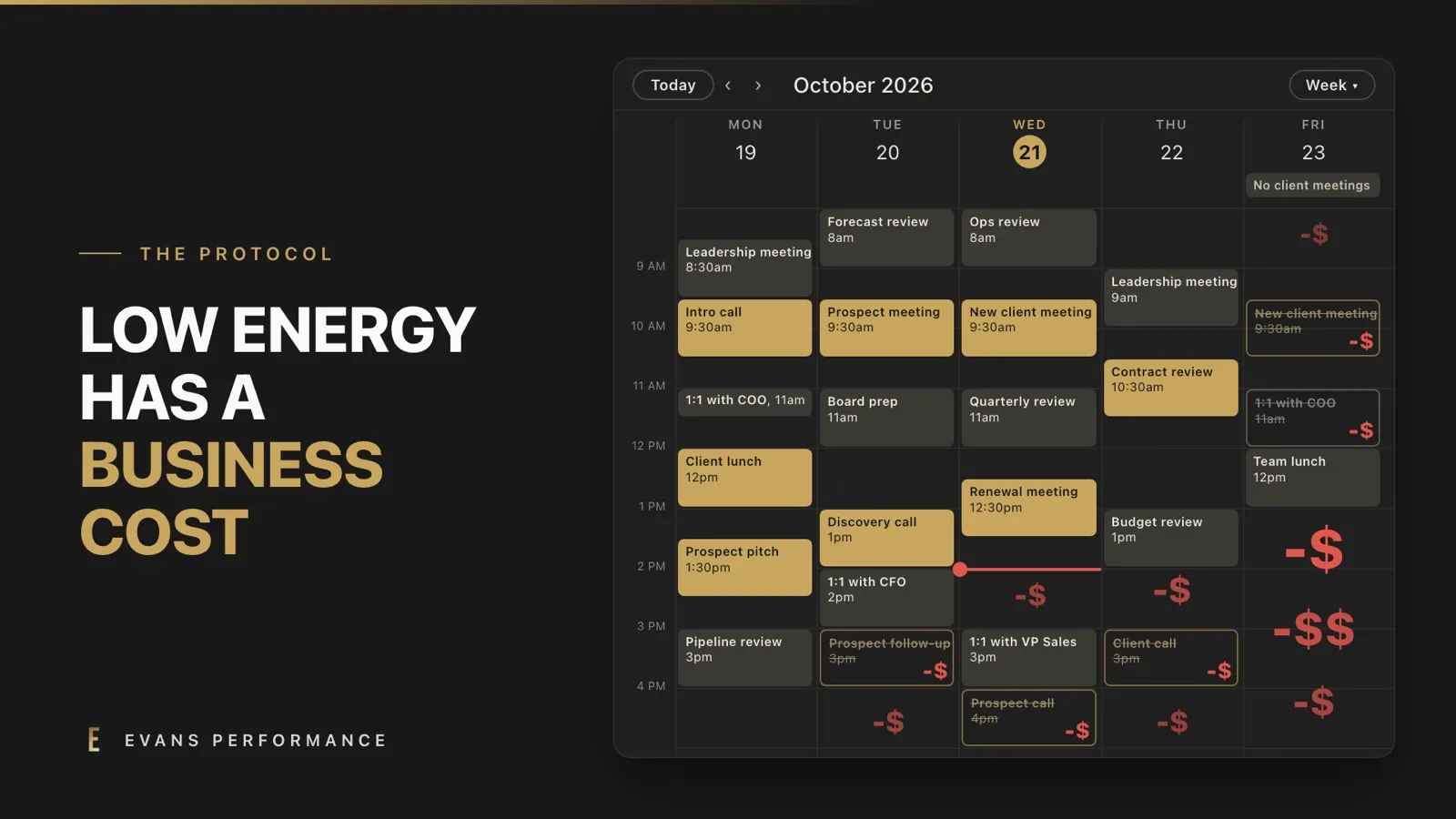
“I don’t schedule any one-on-one meetings or any new client meetings on Fridays intentionally. And I know my work is suffering because of it.”
An insurance executive in his forties told me that on a strategy call. By Friday his energy was gone.
On another call, an attorney who owns his firm had several energy drinks before we spoke at 12:30 on a Monday. He still told me, “I could take a nap right now.”
Both men were describing one of the most common complaints in primary care. In a JAMA study of 1,159 primary care patients, nearly 1 in 5 men called fatigue a major problem. Lab testing failed to explain it. The usual answer is that everything came back within range.
If you’re always tired and your blood work came back normal, your panel was most likely read for disease. Energy drops long before a marker crosses into disease range. A standard annual panel also skips most of the markers that explain fatigue.
Read for energy, your labs tell a different story. For a tired executive with normal labs, the five markers we check first are free testosterone, free T3, fasting insulin, ferritin, and vitamin B12. If those look good, we turn to sleep, meals, caffeine, and training load, which no blood test measures directly.
Normal ranges are built to catch disease
A lab’s reference range covers the middle 95% of the people it tested and exists to flag disease. Inside it, you look like most people, which sets a low bar. Only 12% of American adults met every marker of optimal metabolic health in national survey data from 2009 to 2016.
One man told me on a call, “My testosterone was 423 and she said that was within range.” Most labs print a range near 250 to 1,100 ng/dL, so 270 and 1,000 both come back normal. Our optimal range starts at 600.
We grade every marker against narrower optimal ranges for men, built from the levels published research links to good health.
Five markers that drain energy inside the normal range
Each of these five can sit inside the lab range while it drains your energy.
Free testosterone
SHBG (sex hormone-binding globulin) and albumin carry most of your testosterone. About 2% circulates free, the share that reaches your tissues. SHBG grips tightly, so when it runs high, a normal total can hide a low free level. Labs call 46 to 224 pg/mL normal. We want 105 to 224.
In a study of 3,369 European men aged 40 to 79, fatigue and limited physical vigor tracked with lower testosterone. The most specific signs were sexual, with fewer morning erections, lower desire, and weaker erections.
Sleep, food, strength training, and fat loss all move it. Fix Your Testosterone covers the full hormone chain.
Free T3
TSH, the standard thyroid screen, tells your thyroid to make T4. Your liver and other tissues convert T4 into T3, the active hormone that sets your metabolic pace. Stress, illness, and under-eating slow that conversion, so TSH can read normal while free T3 runs low.
In a Washington University study, adults who had eaten about 1,800 calories a day for six years on average had T3 levels about 20% lower than matched adults on a typical diet. Their TSH and T4 matched.
We want free T3 between 3.0 and 3.5 pg/mL, inside a lab range of 2.3 to 4.2. Eating enough for your training, with carbohydrate around your sessions, is usually the first fix.
Fasting insulin
A fasting insulin of 15 µIU/mL comes back normal. We want 2 to 5.
As your cells resist insulin, your pancreas makes more, so glucose can look normal for years while insulin climbs. In the Whitehall II study of 6,538 British civil servants, insulin sensitivity fell steeply in the five years before a diabetes diagnosis. Fasting glucose climbed sharply only in the last three.
High insulin locks stored fat in place, so you run on blood sugar and slump each time it drops. About 80% of the glucose cleared under insulin’s signal goes into muscle, so strength training is the first lever. Fix Your Metabolism goes marker by marker through the insulin side.
Ferritin
Ferritin is your stored iron. Your body uses iron to carry oxygen and make energy inside your cells. Stores run down well before hemoglobin falls, so a normal blood count can miss low iron.
Standard ranges start as low as 16 ng/mL. We want 45 to 79. The American Gastroenterological Association now uses 45 ng/mL as its cutoff for iron deficiency in patients with anemia, because the old cutoff of 15 missed about 4 in 10 cases.
In a man, low ferritin goes to your physician first. The usual cause is blood loss, most often from the gut. High ferritin climbs with inflammation and insulin resistance. Paired with high iron saturation, it goes to your physician too.
Vitamin B12
Labs flag B12 below about 200 pg/mL. We want it above 545. Your body needs B12 to make red blood cells and keep your nerves working. Running short can leave you tired, foggy, and weak, sometimes with tingling in your hands or feet.
Long-term use of metformin or a daily acid reducer lowers B12. Heavy drinking and a diet light on meat, fish, eggs, and dairy lower it too. If you take either medication, keep taking it as prescribed and bring your B12 result to the physician who manages it.
Two tired executives, opposite fixes
These two executives, composites of patterns we see all the time, show why we read the five markers together.
Two composite executives · Both panels read normal
Same low free testosterone, opposite causes
| Marker and optimal range | Executive 1Trains hard, under-eats | Executive 2Client dinners, long days sitting |
|---|---|---|
| On a standard annual panel | ||
| TSH1.0-2.0 mIU/L | 1.6, optimal | 1.9, optimal |
| Fasting glucose75-86 mg/dL | 77, optimal | 96, above optimal |
| Usually left off | ||
| Free T33.0-3.5 pg/mL | 2.6, below optimal | 3.3, optimal |
| Fasting insulin2-5 µIU/mL | 2.4, optimal | 14, above optimal |
| Ferritin45-79 ng/mL | 38, below optimal | 210, above optimal |
| Vitamin B12545-1,100 pg/mL | 390, below optimal | 610, optimal |
| Total testosterone600-1,100 ng/dL | 560, below optimal | 390, below optimal |
| SHBG40-46 nmol/L | 48, above optimal | 24, below optimal |
| Free testosterone105-224 pg/mL | 93, below optimal | 93, below optimal |
| First fix | More food, carbs around training | Strength training and fat loss |
Composite examples built from patterns we see often. Every value sits inside the standard lab range, so both panels come back normal. Free testosterone is calculated from total testosterone, SHBG, and an albumin of 4.4 g/dL.
Executive 1 trains hard, eats once or twice a day, and drinks coffee until dinner. Low fuel pushed his SHBG up and his free T3 down.
Client dinners, drinks, and long days in a chair pushed Executive 2’s fasting insulin to 14. High insulin lowered his SHBG, which pulled his total testosterone down with it.
Both men land at 93 pg/mL of free testosterone for opposite reasons. The usual advice to eat less and train more would help Executive 2 and sink Executive 1.
Eating more can fix Executive 1’s fatigue without stalling fat loss. Luke, a 44-year-old doctor of physical therapy who runs a hospital department, ate about 45% more each day in his first 90 days with us. He went from 190 to 169 pounds and from a 38-inch waist to a 32.
What blood work can’t see
Rule out sleep apnea first. In a Wisconsin study, an estimated 82% of men with moderate to severe cases had never been diagnosed. If you snore, wake up unrefreshed, or fight sleep in meetings, ask your physician about a sleep study.
Short sleep shows up in your labs eventually. One week of five-hour nights cut daytime testosterone 10 to 15% in healthy young men.
Alcohol hits recovery first. In 4,098 Finnish employees wearing heart rate monitors, recovery in the first three hours of sleep fell about 9 percentage points after light drinking and 39 after heavy drinking. Our 222 Rule keeps alcohol in clients’ lives at two drinks, two days a week, finished at least two hours before bed.
Under-eating leaves you leaning on caffeine by mid-afternoon. Even six hours before bed, 400 mg of caffeine, about four cups of coffee, cut measured sleep by more than an hour in one study.
We read sleep, HRV, and recovery from your wearable, which catches these drains before your blood does.
The tests to ask for
Take this list to your next physical. Ask for each test by name and get the actual values back, so you can read them against the optimal ranges above.
Bring this to your next physical
The fatigue panel
Testosterone
- Total testosterone
- SHBG and albumin
- Free testosterone, calculated
Thyroid
- TSH
- Free T3 and free T4
- Reverse T3
Blood sugar
- Fasting insulin and fasting glucose
- HbA1c
- Triglycerides and HDL
Iron and red blood cells
- Ferritin
- Iron, TIBC, and transferrin saturation
- CBC with hemoglobin and MCV
Vitamins and inflammation
- Vitamin B12 and MMA
- Folate
- Vitamin D (25-OH)
- hs-CRP
Draw it right
- Book an early-morning draw after fasting 10 to 12 hours, water only.
- Skip hard training for two to three days before. Hard sessions can raise liver enzymes and creatinine for up to 72 hours.
- Pause biotin a few days ahead. A common dose skewed 9 of 23 lab tests in a small JAMA study.
- Retest at the same lab, at the same time of day.
When fatigue belongs with your physician
Coaching works in the gap between normal and optimal. These belong with your physician first.
- Fatigue with weight loss you can’t explain, fevers, or night sweats
- Chest pain or shortness of breath when you exert yourself
- Loud snoring with daytime sleepiness
- Low hemoglobin or low ferritin
- TSH outside the lab range
- Fasting glucose of 126 mg/dL or higher, or HbA1c of 6.5% or higher
- Low mood or lost interest in things you enjoy for more than two weeks
How fast energy comes back
Energy usually comes back before the lab markers move. The two men from the opening started with us in August.
Monthly scorecards · Onboarding to week eight
The two men from the top of this article
The insurance executive
- Energy2 to 8 of 10
- Resting heart rate77 to 56 bpm
- Restful nights2 to 5 a week
- Weight, month oneDown 11.3 lbs
The attorney
- Energy1 to 7 of 10
- Brain fog (10 is worst)10 to 3
- Restful nights0 to 5 a week
- Weight, month oneDown 10 lbs
From each man's monthly scorecards in our client portal. Energy and brain fog are self-rated from 1 to 10. Weight change covers the first month.
Both had their blood work scored against optimal ranges, with nutrition targets built from it, weekly check-ins, and monthly scorecards. Our average client sees a 66% increase in energy in the first month.
Our online executive health coaching starts from 100+ biomarkers, so the first month goes straight at the markers draining you.
Free guide
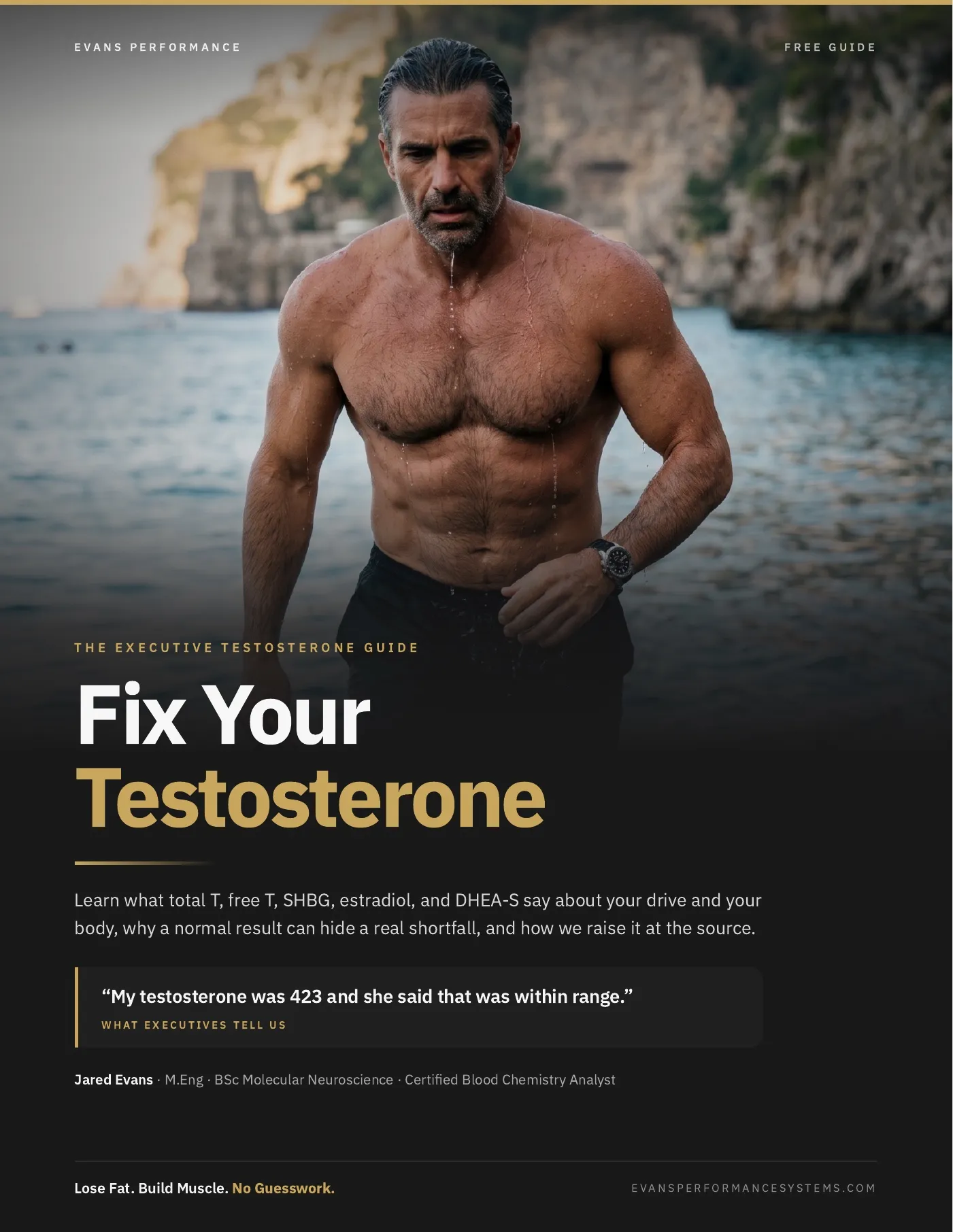
If your labs say you're fine and your energy says otherwise, start with Fix Your Testosterone. It walks through the nine markers behind energy and drive, the five ways testosterone runs low, and a 14-day plan you can start this week.
Common questions
Is it normal to feel tired all the time after 40?
Some decline comes with age. In the Massachusetts Male Aging Study, men aged 40 to 70 lost about 1.6% of their total testosterone each year. Constant fatigue usually traces to sleep, body fat, blood sugar, or training load. Each of those responds to the right plan.
Can low vitamin D make you tired?
It can. A randomized trial gave one dose of vitamin D or a placebo to 120 tired adults, mostly in their 20s and 30s, with vitamin D under 20 ng/mL. Four weeks later, 72% of the vitamin D group reported less fatigue, against 50% on placebo. Lab ranges for vitamin D start at 30 ng/mL. We want 50 to 90. Let your labs set the dose, because too much can raise your calcium.
How soon should I retest after making changes?
Give a change about three months. HbA1c reflects roughly the last three months of blood sugar. Testosterone takes months to move as well. Our clients run their second panel in month four or five, retesting the markers that matter for them.
Sources
- [1] Kroenke K, Wood DR, Mangelsdorff AD, Meier NJ, Powell JB. Chronic fatigue in primary care. Prevalence, patient characteristics, and outcome. JAMA. 1988;260(7):929-34.
- [2] Araújo J, Cai J, Stevens J. Prevalence of Optimal Metabolic Health in American Adults: National Health and Nutrition Examination Survey 2009-2016. Metab Syndr Relat Disord. 2019;17(1):46-52.
- [3] Wu FC, Tajar A, Beynon JM, et al. Identification of late-onset hypogonadism in middle-aged and elderly men. N Engl J Med. 2010;363(2):123-35.
- [4] Corona G, Rastrelli G, Monami M, et al. Body weight loss reverts obesity-associated hypogonadotropic hypogonadism: a systematic review and meta-analysis. Eur J Endocrinol. 2013;168(6):829-43.
- [5] Fontana L, Klein S, Holloszy JO, Premachandra BN. Effect of long-term calorie restriction with adequate protein and micronutrients on thyroid hormones. J Clin Endocrinol Metab. 2006;91(8):3232-5.
- [6] Tabák AG, Jokela M, Akbaraly TN, Brunner EJ, Kivimäki M, Witte DR. Trajectories of glycaemia, insulin sensitivity, and insulin secretion before diagnosis of type 2 diabetes: an analysis from the Whitehall II study. Lancet. 2009;373(9682):2215-21.
- [7] DeFronzo RA, Tripathy D. Skeletal muscle insulin resistance is the primary defect in type 2 diabetes. Diabetes Care. 2009;32(Suppl 2):S157-63.
- [8] Ko CW, Siddique SM, Patel A, et al. AGA Clinical Practice Guidelines on the Gastrointestinal Evaluation of Iron Deficiency Anemia. Gastroenterology. 2020;159(3):1085-1094.
- [9] Jehn M, Clark JM, Guallar E. Serum ferritin and risk of the metabolic syndrome in U.S. adults. Diabetes Care. 2004;27(10):2422-8.
- [10] Lam JR, Schneider JL, Zhao W, Corley DA. Proton pump inhibitor and histamine 2 receptor antagonist use and vitamin B12 deficiency. JAMA. 2013;310(22):2435-42.
- [11] Aroda VR, Edelstein SL, Goldberg RB, et al. Long-term Metformin Use and Vitamin B12 Deficiency in the Diabetes Prevention Program Outcomes Study. J Clin Endocrinol Metab. 2016;101(4):1754-61.
- [12] Vermeulen A, Verdonck L, Kaufman JM. A critical evaluation of simple methods for the estimation of free testosterone in serum. J Clin Endocrinol Metab. 1999;84(10):3666-72.
- [13] Young T, Evans L, Finn L, Palta M. Estimation of the clinically diagnosed proportion of sleep apnea syndrome in middle-aged men and women. Sleep. 1997;20(9):705-6.
- [14] Leproult R, Van Cauter E. Effect of 1 week of sleep restriction on testosterone levels in young healthy men. JAMA. 2011;305(21):2173-4.
- [15] Pietilä J, Helander E, Korhonen I, Myllymäki T, Kujala UM, Lindholm H. Acute Effect of Alcohol Intake on Cardiovascular Autonomic Regulation During the First Hours of Sleep in a Large Real-World Sample of Finnish Employees: Observational Study. JMIR Ment Health. 2018;5(1):e23.
- [16] Drake C, Roehrs T, Shambroom J, Roth T. Caffeine effects on sleep taken 0, 3, or 6 hours before going to bed. J Clin Sleep Med. 2013;9(11):1195-200.
- [17] Li D, Radulescu A, Shrestha RT, et al. Association of Biotin Ingestion With Performance of Hormone and Nonhormone Assays in Healthy Adults. JAMA. 2017;318(12):1150-1160.
- [18] Feldman HA, Longcope C, Derby CA, et al. Age trends in the level of serum testosterone and other hormones in middle-aged men: longitudinal results from the Massachusetts male aging study. J Clin Endocrinol Metab. 2002;87(2):589-98.
- [19] Nowak A, Boesch L, Andres E, et al. Effect of vitamin D3 on self-perceived fatigue: A double-blind randomized placebo-controlled trial. Medicine (Baltimore). 2016;95(52):e5353.
This article is for educational purposes only and is not medical advice. Consult your physician before making changes to your health, training, or supplementation.